Avenue Winston Churchill, Hippodrome, Yaoundé

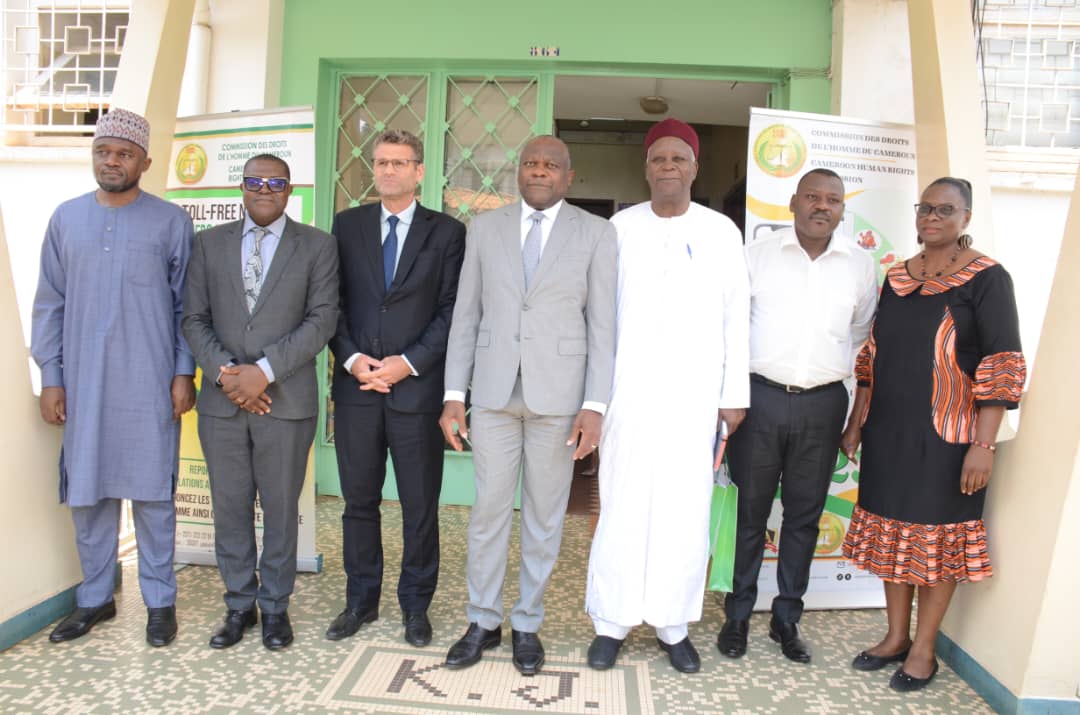
On 5 September 2024, Prof James Mouangue Kobila, Chairperson of the Cameroon Human Rights Commission (CHRC), received in audience Mr Stéphane Bonamy, Head of the International Committee of the Red Cross (ICRC) Sub-Regional Delegation for Central Africa, at the Institution’s Head Office.
The high representative was accompanied by Mr Timothée Fomegang, ICRC’s legal adviser.
At the meeting, the CHRC Chairperson was assisted by:
Commissioner Boukar Seiny Lamine, member of the Sub-Commission on the Prevention of Torture in Places of Detention
Mr Gabriel Nonetchoupo, Head of the Division for the Promotion and Protection of Human Rights
Mr Mamouda Férikouop, Chief of Staff at the Chairperson’s Office, and
Ms Mabel Shu Nyamboli, Acting Head of the Cooperation, Documentation and Research Service.
The visit of the ICRC’s high representative had four objectives:
to establish contact with the CHRC,
to present the activities of the ICRC and its working methods in the fulfilment of its mandate in Cameroon,
to identify points of convergence between the mandate of the Commission and that of the ICRC, and
to explore possibilities for concerted action.
In his opening remarks, Prof James Mouangue Kobila welcomed his guest and highlighted the significance of this visit occurring during the celebrations of the 75th anniversary of the adoption of the Geneva Conventions of 1949.
Taking the floor, Mr Stéphane Bonamy recalled that the ICRC’s mandate is to provide assistance to vulnerable groups in situations of armed conflict or insecurity and to strengthen the application of international humanitarian law.
Concerning enhancing the resilience of the civilian population, particularly in the Far North, North-West and South-West Regions, the Head of the ICRC’s Sub-Regional Delegation explained in detail that the ICRC provides support to improve the provision of basic social services, such as access to health, drinking water and education, as well as support for income-generating activities.
Following the presentation of the ICRC’s activities, the Chairperson of the CHRC stated that “we know more about the ICRC’s mandate, its operational work in the field, the difficulties and delicate situations”. Prof James Mouangue Kobila also noted that the ICRC and the CHRC “share certain areas of intervention as well as certain working methods, such as discretion”.
During the discussions, Mr Bonamy lamented the fact that the neutral space for populations in places prone to insecurity often does not exist: “The populations are between the devil and the deep blue sea, often suspected of collaborating either with the defence and security forces or with the terrorists,” explained the CHRC guest.
Commissioner Seiny Lamine Boukar, traditional ruler and former mayor of Kolofata Council, referred to the dangerous nature of terrorist attacks, particularly in the Far North Region, and noted that members of vigilance committees were very often victims of reprisals because of their assistance in securing their communities. The CHRC member also mentioned the regular visits by members of the Sub-Commission for the Prevention of Torture to places of detention, to improve detention conditions of persons deprived of their liberty. He also drew the attention of the Head of the ICRC’s Sub-Regional Delegation to the fact that the provision of assistance to families in need must contribute to improving the living conditions of the local population and not widen the gap in living standards. His Majesty Seiny Lamine Boukar also suggested that to strengthen the implementation of the right to food for detainees, emphasis should be placed, as far as possible, on assigning detainees to prisons close to their place of origin in order to bring them closer to their families.
Considering that the CHRC and the ICRC both have a mandate of promotion and protection of human rights, Prof James Mouangue Kobila and his guest agreed on the need to respect the rights of vulnerable groups in a context of insecurity, regardless of the legal classification of the situation. They also committed themselves to carry out advocacy on behalf of the families of those who disappeared at the start of the fight against Boko Haram, and condemned the attacks on education.
Following the proceedings, which lasted two hours and twenty-three minutes, the head of the ICRC delegation told the press: “This was an initial meeting. We have common objectives, which are to find the best ways to protect vulnerable groups and civilians in situations where they are threatened by weapons and violence”.
#CHRC
#CDHC
#1523
#Accredited with A Status
#Accréditée au Statut A