Avenue Winston Churchill, Hippodrome, Yaoundé

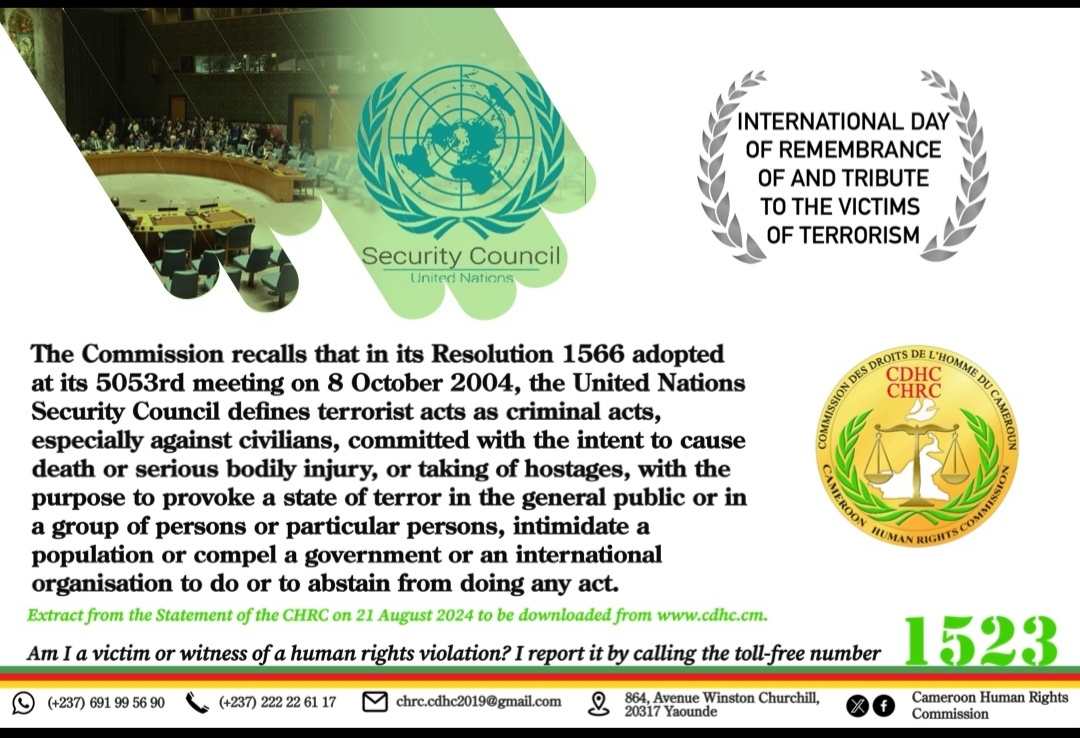
The Commission recalls that in its Resolution 1566 adopted at its 5053rd meeting on 8 October 2004, the United Nations Security Council defines terrorist acts as criminal acts, especially against civilians, committed with the intent to cause death or serious bodily injury, or taking of hostages, with the purpose to provoke a state of terror in the general public or in a group of persons or particular persons, intimidate a population or compel a government or an international organisation to do or to abstain from doing any act. The Commission acknowledges that immediate victims of terrorist acts, and families of injured or killed victims and all people involved (witnesses and professionals at the scene) all need an urgent psychological assistance, followed by a personalized listening and support proposal. They must be the central focus of efforts and actions aimed at providing them the support and justice they deserve. The Commission notes that due to these multiple attacks, forcibly displaced populations, are among vulnerable and marginalised groups that suffer from physical and psychological trauma, and a great socioeconomic vulnerability. The Commission notes with deep concern and deplores: – the rape of several women resulting in their infection with sexually transmitted diseases or unwanted pregnancies – the forced recruitment of children into non state armed groups – the persistence of kidnappings with ransom demands – the killings of civilians alleged to have collaborated with Government Defense and Security Forces or expressed disapproval of the secessionist agenda. The Commission expresses satisfaction that of the 220 recommendations accepted by the State during the adoption of Cameroon’s Report after undergoing the Fourth cycle of the Universal Periodic Review (UPR) on 26 March 2024, six are focused on assisting victims of terrorism. The Commission has distributed these relevant recommendations to Government bodies, civil society organisations and political parties, with each entity expected to implement the recommendations falling under their respective domains. The Commission recommends that the State should undertake more extensive awareness-raising efforts targeting the general population, civil society organisations, media outlets, and local communities. This is essential to achieve greater involvement of victims, their representatives, rights holders and CSOs specialised in the defence of victims’ rights in counter terrorism strategies and practices. Such involvement is absolutely critical for preventing radicalisation, reporting suspicious activities and encouraging terrorists to lay down their arms and surrender at the nearest Disarmament, Demobilisation, and Reintegration Centre. #CHRC #CDHC #1523 #Accredited with A Status #Accréditée au Statut A