Avenue Winston Churchill, Hippodrome, Yaoundé

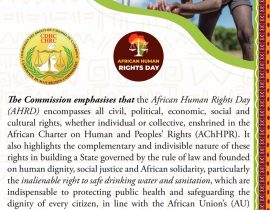
21 October 2026The Commission emphasises that the African Human Rights Day (AHRD) encompasses all civil, political, economic, social and cultural rights, whether individual or collective, enshrined in the African Charter on Human and Peoples’ Rights (AChHPR). It also highlights the complementary and indivisible nature of these rights in building a State governed by the rule of law and founded on human dignity, social justice and African solidarity, particularly the inalienable right to safe drinking water and sanitation, which are indispensable to protecting public health and safeguarding the dignity of every citizen, in line with the African Union’s (AU) theme for 2026: Assuring Sustainable Water Availability and Safe Sanitation Systems to Achieve the Goals of Agenda 2063.
The Commission recalls that access to safe drinking water and sanitation cannot be reduced to a mere development or infrastructure objective but contributes to the realisation of human and peoples’ rights, a pillar of human dignity, and calls for appropriate due-diligence measures to protect life in the face of health and environmental challenges. Accordingly, on the occasion of the 45th anniversary of the adoption and the 40th anniversary of the entry into force of the African Charter on Human and Peoples’ Rights (AChHPR), the Commission calls upon each public and private actor to take concrete measures, each in its sphere of competence, to ensure the effective realisation of these rights, thereby contributing to social justice and the achievement of Agenda 2063 of the African Union.
The Commission commends the holding of the meeting chaired by Chief Dr Joseph Dion Ngute, Prime Minister, Head of Government, on 28 April 2026, in Yaoundé, to conduct a mid-term assessment of the implementation of recommendations arising from the fourth cycle of the Universal Periodic Review (UPR); During the meeting, members of the Government or their representatives presented, sector by sector, the measures taken and those still to be implemented in respect of the 220 recommendations accepted by Cameroon out of the 291 made in 2023, within the framework of a three-year roadmap covering the 2026–2028 period; the implementation of these recommendations also encompasses measures relating to civil and political rights, economic, social and cultural rights, as well as individual and collective rights.
The Commission commends the implementation of customs incentives for persons with disabilities, since the entry into force of the Finance Law for the 2026 financial year. These incentives include exemption from import customs duties and taxes on equipment, materials and vehicles specially designed or adapted to meet their needs, when imported by holders of a disability card issued by the Ministry of Social Affairs (MINAS), or by approved specialised centres providing care for this category of vulnerable persons, in accordance with the provisions of the first paragraph of Section 8 of Law No. 2025/012 of 17 December 2025 the Finance Law of the Republic of Cameroon for the 2026 financial year. The list of goods in question and the eligibility criteria for this exemption, as set out in Section 8(2) are to be established by an instrument issued by the Minister of Finance following consultation with MINAS. Circular No. 00000203/MINFI/DGD of 12 February 2026 and Section IV of Circular No. 410/MINFI/DGD of 18 May 2026 respectively establish the said list and eligibility.
The Commission draws particular attention to the disproportionate impact that inadequate access to drinking water and sanitation has on women and girls, particularly risks to their health, difficulties in managing menstrual hygiene, violations of their privacy and dignity, and exposure to violence when collecting water and accessing sanitation facilities. It also emphasises that the responsibility of collecting and carrying water, coupled with the additional domestic and care duties arising from water shortages, hinders girls’ education and restricts women’s prospects of paid employment and economic independence.
The Commission recommends the systematic integration of a gender-equality approach into the design and implementation of water supply and sanitation policies and infrastructure and to ensure women’s effective participation in decision-making and water-resource management mechanisms.
The Commission specifically recommends that the government should strengthen sustainable mechanisms for preventing and peacefully settling agro-pastoral conflicts, ensuring the effective participation of farmers, herders, and local authorities. This should entail a combination of early warning systems, dialogue and mediation, joint management of agricultural and pastoral land, demarcation and securing of transhumance corridors, protection of crops and livestock, and equitable access to water points and grazing land. The Commission also recommends that the government should ensure that aggrieved persons have access to effective remedies and fair reparation for harm suffered.
The Commission specifically recommends that beneficiary councils should ensure the efficient and transparent use of the 8.5 billion FCFA allocation transferred by the Ministry of Water Resources and Energy (MINEE) in 2026 for the provision of drinking water, to sustainably improve access to water for the population, prioritising the least-served localities. The Commission recommends that the said councils should ensure the quality of the facilities and their effective commissioning, provide the necessary maintenance resources, and regularly report on the use of funds and results obtained.
The Commission also urges the beneficiary councils to ensure the effective participation of women in the planning, management and monitoring of projects and take the specific needs of women and girls into account when selecting the location of water points and determining access arrangements. This will help to reduce the burden of water collection, mitigate the risks to which women and girls are exposed and ensure that menstrual hygiene is managed in a way that safeguards their health, privacy and dignity.
The Commission commends the sustained efforts of public authorities and their partners in strengthening the realisation of human and peoples’ rights in Cameroon, in line with the AU’s 2026 central theme recalled above as well as 45th anniversary of the adoption coupled with the 40th anniversary of the entry into force of the AChHPR, in particular through the continuation of the drafting process of the bill on combating gender-based violence was discussed on 7 October 2026 during a meeting between the Ministry of Women’s Empowerment and the Family (MINPROFF) and the European Union Ambassador to Cameroon; at the meeting, it was reported that the bill was with the Presidency of the Republic, pending possible submission to Parliament.
The Commission recalls the actions it has undertaken, as well as those in which it has participated, in strengthening the promotion and protection of human and peoples’ rights, including the conduct of a field investigation by the CHRC Littoral Regional Branch on 5 June 2026, in Dehane and Apouh-à-Ngong, in the Édéa I Sub-division, following a complaint lodged by the Association des Femmes riveraines d’Édéa (AFRISE) on alleged violations of the land, cultural and environmental rights of the local populations due to SOCAPALM’s activities; In a letter dated 10 June 2026 addressed to the Governor of the Littoral Region, the Regional Branch recommended suspending replanting operations near homes and burial sites and removing obstructions impeding movement and access to watercourses.